
Carr Drives Michigan to Victory
By Matthew Flesher • October 18, 2026
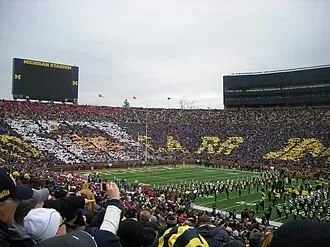
Michigan's offense went nowhere in the first half against Penn State, but freshman Tommy Carr provided the spark the Wolverines desperately needed.
By The Numbers
-
Final Score: Michigan 21, Penn State 18 — Saturday, October 17, 2026, Michigan Stadium.
-
Quarter Breakdown: Michigan: 0 | 0 | 14 | 7 = 21. Penn State: 3 | 0 | 0 | 15 = 18.
-
Total Offense: Michigan 301 yards (211 rushing, 90 passing). Penn State 332 yards (65 rushing, 267 passing).
-
Turnovers: Michigan 2 (two interceptions). Penn State 3 (two interceptions, one lost fumble). Turnover margin: Michigan +1.
-
Penalties: Michigan 8 for 63 yards. Penn State 5 for 53 yards.
-
Michigan Passing: Tommy Carr 5-of-7, 47 yards, 0 TD, 0 INT. Bryce Underwood 5-of-11, 43 yards, 0 TD, 2 INT.
-
Michigan Rushing: Savion Hiter 11 carries, 78 yards; Jordan Marshall 14 carries, 49 yards, 1 TD; Bryson Kuzdzal 2 carries, 38 yards, 1 TD; Tommy Carr 4 carries, 36 yards, 1 TD.
-
Michigan Receiving: JJ Buchanan 3 receptions, 36 yards; Hogan Hansen 2 receptions, 31 yards; Andrew Marsh 3 receptions, 21 yards.
-
Michigan Defense: Chris Bracy recorded 8 tackles, an interception, a sack and a forced fumble. Rod Moore added an interception, Troy Bowles recorded 10 tackles, and Enow Etta recovered a critical fourth-quarter fumble.
-
Penn State Leaders: Rocco Becht 28-of-44, 267 yards, 1 TD, 2 INT; Carson Hansen 15 carries, 51 yards, 1 TD; Chase Sowell 11 receptions, 151 yards, 1 TD.
-
Third Downs: Michigan 5-of-12 (41.7%). Penn State 4-of-12 (33.3%).
-
Fourth Downs: Both teams 1-of-1 (100%).
-
Time of Possession: Michigan 27:58. Penn State 32:02.
-
Records: Michigan 4-2 (1-2 Big Ten). Penn State 3-4 (0-4 Big Ten).
Carr Drives Michigan to Victory
For thirty minutes Saturday afternoon, Michigan's offense looked like it had accidentally left the playbook somewhere on I-94.
Then Tommy Carr entered the game.
And suddenly, Michigan remembered how to play football.
The Wolverines overcame a miserable first half to defeat Penn State 21-18 at Michigan Stadium, snapping a two-game losing streak and earning their first Big Ten victory of the season.
The difference wasn't complicated. Michigan changed quarterbacks, started running the football effectively, and finally looked like an offense capable of moving the chains without requiring divine intervention.
Carr wasn't spectacular statistically. He didn't need to be.
He simply made the offense work.
A First Half Worth Forgetting
Michigan entered Saturday desperately needing a win after consecutive conference losses to Iowa and Minnesota.
Instead, the Wolverines spent the opening half reminding everyone why they were winless in Big Ten play.
Bryce Underwood completed just five of eleven passes for 43 yards and threw two interceptions. Michigan managed only 80 total yards and went into halftime trailing 3-0.
Three points.
Against an offense that couldn't score.
Somehow, Michigan was fortunate to be down only three.
Penn State wasn't exactly putting on an offensive clinic either, but the Nittany Lions controlled possession and repeatedly forced Michigan into uncomfortable situations.
Underwood struggled with his reads and decision-making. The offense couldn't establish any rhythm, and offensive coordinator Jason Beck's approach wasn't producing results.
Something needed to change.
To head coach Kyle Whittingham's credit, something did.
Enter Tommy Carr
Freshman Tommy Carr replaced Underwood to begin the second half, and the difference was noticeable almost immediately.
Not because Carr started throwing the ball all over Michigan Stadium.
Quite the opposite.
Carr completed five of seven passes for just 47 yards. But he protected the football, made timely decisions, and added 36 rushing yards.
More importantly, the offense appeared organized.
Carr seemed comfortable getting Michigan into favorable plays at the line of scrimmage. The running game found room that simply hadn't existed during the first half.
And perhaps most noticeably, the players around him responded.
Michigan scored 21 points with Carr directing the offense after producing exactly zero with Underwood.
That's a pretty compelling halftime adjustment.
Whittingham acknowledged afterward that the quarterback change was intended to generate a spark. Carr delivered exactly that.
The Running Game Finally Shows Up
Michigan's offensive resurgence wasn't built on Carr's arm.
It was built on the ground.
The Wolverines finished with 211 rushing yards, averaging six yards per carry. That was the kind of physical running performance Michigan has struggled to produce consistently this season.
The breakthrough came early in the third quarter.
Following a Penn State interception, Bryson Kuzdzal broke loose for a 43-yard touchdown run, giving Michigan a 7-3 lead.
Suddenly, the Big House had something to cheer about.
Later in the quarter, Carr helped engineer an 11-play, 74-yard touchdown drive. His 22-yard quarterback draw put Michigan near the goal line, and Jordan Marshall finished the possession with a one-yard touchdown run.
Michigan led 14-3.
Savion Hiter contributed 78 rushing yards on just 11 carries, including a 41-yard burst. Marshall added 49 yards and a touchdown.
The difference wasn't simply that Michigan ran more effectively. The offensive approach became more direct.
Instead of repeatedly trying to manufacture something around the edges, Beck leaned into the interior running game.
Michigan's offensive line responded, and Carr's ability to threaten defenses with his legs created another problem for Penn State.
Sometimes football really isn't that complicated.
The Defense Deserves Its Share of the Credit
Carr will deservedly receive most of the headlines, but Michigan's defense made the comeback possible.
Penn State finished with 332 total yards, but the Wolverines held the Nittany Lions to just 65 rushing yards on 30 attempts.
More importantly, Michigan forced three turnovers.
Rod Moore and Chris Bracy each intercepted Penn State quarterback Rocco Becht, providing Michigan with valuable opportunities as the offense began finding its footing.
Bracy was particularly impressive.
The defensive back finished with eight tackles, an interception, a sack and a forced fumble.
His biggest contribution came late in the fourth quarter.
With Penn State trailing 14-11 and threatening to take the lead, Bracy sacked Becht and forced a fumble that Enow Etta recovered.
Michigan took over deep in Penn State territory.
Three plays later, Carr scrambled 12 yards for a touchdown on third down.
Michigan led 21-11 with 2:58 remaining.
That defensive play ultimately provided the difference.
There were problems, of course.
Penn State receiver Chase Sowell caught 11 passes for 151 yards, and Becht finished with 267 passing yards.
Michigan's secondary still has work to do.
But when the Wolverines absolutely needed a defensive play, they got one.
Penn State Makes It Interesting
Naturally, Michigan couldn't simply close out the game comfortably.
That would have been entirely too convenient.
Penn State responded to Carr's touchdown with a 73-yard drive, capped by Becht's 24-yard touchdown pass to Sowell.
The score narrowed to 21-18 with 1:11 remaining.
Michigan recovered the ensuing onside kick and ran out the clock.
The Wolverines had survived.
It wasn't pretty, but after two consecutive losses, nobody was going to complain about the artistic quality of the victory.
What Happens to Bryce Underwood?
This is now the biggest question facing Michigan football.
Underwood entered the season with enormous expectations. His physical tools remain impressive, but his decision-making and turnover problems have become increasingly difficult to ignore.
Saturday's two interceptions brought his season total to six.
Carr, meanwhile, demonstrated something Michigan desperately needed: the ability to operate the offense without making costly mistakes.
That doesn't automatically mean Carr should be handed the starting job permanently.
Seven passing attempts aren't enough to evaluate a quarterback's complete ability.
But the difference in offensive execution was impossible to miss.
Carr appeared more comfortable directing the offense, and Michigan played with greater confidence around him.
Whittingham declined to name a starter for next week's game immediately after Saturday's victory.
That's understandable.
But after what happened against Penn State, the coaching staff has a legitimate quarterback decision to make.
And Carr has certainly earned a serious look.
The Bigger Picture
Michigan improves to 4-2 overall and 1-2 in Big Ten play.
The victory prevents an 0-3 conference start and provides some much-needed momentum after consecutive disappointing performances.
Still, this wasn't a complete turnaround.
Michigan produced only 301 total yards, committed eight penalties, and allowed Penn State to remain within striking distance until the final minute.
The passing game remains limited, and the secondary continues to surrender too many yards.
But there were encouraging signs.
The running game looked dangerous. The defense generated turnovers. And the quarterback change demonstrated that Michigan has another option when the offense stalls.
Perhaps most importantly, the Wolverines finally showed an ability to make meaningful adjustments during a game.
That's something this team has been missing.
Next Up: Indiana
Michigan hosts No. 5 Indiana on Saturday, October 24, at noon Eastern on Fox.
The Hoosiers arrive following a 19-15 loss to Ohio State that snapped their 22-game winning streak.
Indiana will present a considerably tougher challenge than a struggling Penn State team.
Michigan won't be able to afford another scoreless first half or multiple turnovers at quarterback.
The Wolverines will need a more consistent passing attack, another productive performance on the ground, and a defense capable of limiting explosive plays.
And they'll need to decide who's taking the first snap.
Final Thoughts
Tommy Carr didn't single-handedly beat Penn State.
Michigan's defense forced three turnovers. The running backs delivered explosive plays. And the coaching staff finally made adjustments that worked.
But Carr was the catalyst.
He brought stability to an offense that had looked completely lost, made the plays Michigan needed, and helped turn a three-point halftime deficit into a much-needed victory.
Whether he becomes Michigan's permanent starting quarterback remains to be seen.
For now, the Wolverines have their first Big Ten win, a little momentum, and a quarterback controversy that suddenly looks a lot more interesting.
Michigan needed a spark. Tommy Carr provided one.
Comments
Sign in to leave a comment.
Loading comments…